Spurling
Spurling is an anchor alarm on your members' bridges. It sounds when the ship's own anchor drops, or starts to drag.
Your loss prevention team brings it to members. A unit at each chain stopper counts the chain, and a computer on the bridge reads the ship's own steering and speed.
Cameras and AIS replays look for the ship over a cable.
The Eagle S appeal of 27 August 2026 drew its line at the moment that ship's bridge was asked about its anchors.
For who else was near the cable, a camera or the AIS replay is the better tool.
Spurling tells the member's own bridge, within seconds, that its chain is running. AIS is already logged ashore, and a MarineTraffic account is free.
| Weighed on | Spurling | Quartermaster cameras | Orca AI lookout | AIS replay |
|---|---|---|---|---|
| On the member's ship | Fitted at a port call | Hosts mostly small operators | On its bridge | Its AIS is aboard |
| Watches its own anchor | Chain and motion | Detects vessels nearby | Watches the water | Track, read later |
| Bridge told at the time | Seconds after chain runs | Hazard alerts to hosts | Lookout alerts | Ashore, afterwards |
| A timed record | Held by the member | Timestamped, sold to buyers | Encounter data | Logged by AIS networks |
| Sees other ships | No camera | On camera to 10 NM | On camera | All that transmit |
€390per fitted ship a month,with every unit lent and nothing to buy
A Quartermaster mast costs its host vessel nothing. In a Spurling trial season the club pays all or part and the member the rest, then every month after. Quartermaster's founder calls selling sensors to low-margin fleets a hard pitch, so ours are lent.
Covered
chain units, panel, sounders, computer, cable and the shore service.
Trial season
six months, about €2,340 a ship. The club pays all or part, as the order form sets; the member pays the rest, then monthly.
Never charged
fitting, cabling, replacements, removal, notices, users, the season report.
- The price per ship holds 24 months from its first fit
- Each ship's first fourteen days at sea are not invoiced
- One six-month season is the only commitment, then 30 days' notice
- Units down over 72 hours: that month is not invoiced
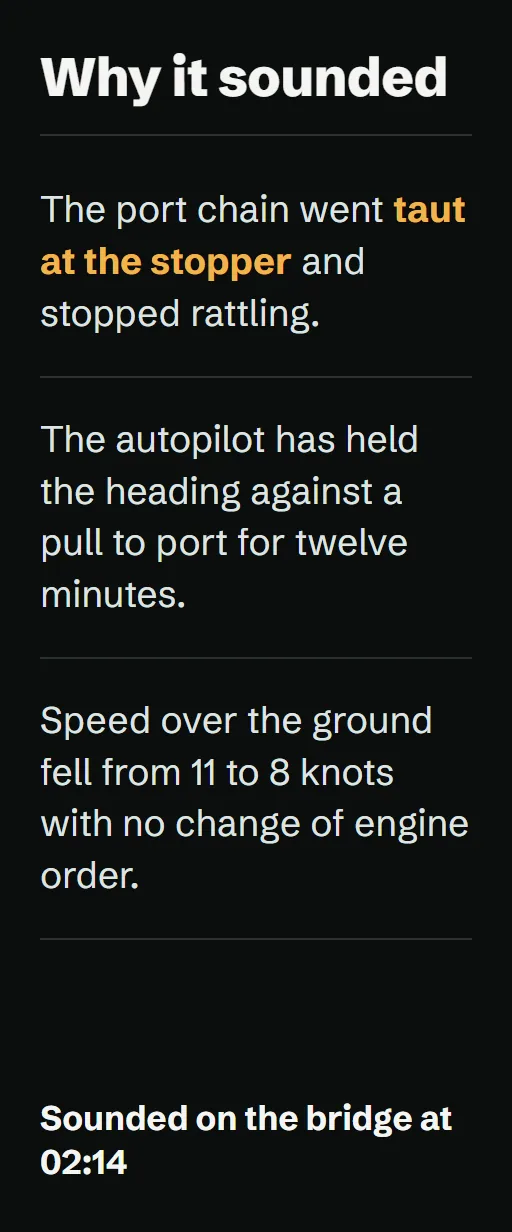
Nobody on watch sees the anchor.The chain is counted at the stopper.A drag shows up in the steering.The officer of the watch answers.
Running chain sounds by a fixed rule within five seconds, and no model can silence it. For an anchor the count misses, a model aboard reads the motion and sounds once it has stayed sure for three minutes.
What it reads
Chain, rudder, lost speed and the track
When it sounds
Five seconds after chain runs, or when the model stays sure for three minutes
Who decides
The officer of the watch, never the model. It has no output to steering, engine or windlass
What can fool it
Wind, current and loading move the same numbers a drag does
What it learned from
Simulated drags per hull type, then the ship's first fourteen days at sea
The record can be read against your member
An alarm writes down when the bridge was told. The Eagle S appeal judged the crew's conduct after the authorities' call apart from the anchor's first loss.
AIS and the voyage data recorder keep the night anyway. Eagle S was placed over Estlink 2 from replayed MarineTraffic positions.
The alarm shortens the minutes nobody aboard knew. The record is the member's, on cloud infrastructure in Stockholm; a court can still order it.
Far from the bow
Ships already carrying a bridge anchor alarm need nothing from us.
Built for
Cable-water fleets
Entered ships crossing Baltic or North Sea cables monthly
Bridge far aft
Large ships that may not notice a dropped anchor
Not for
Small vessels
Under about 100 meters, the watch sees its anchors
Watching other ships
Cameras or an AIS replay do that
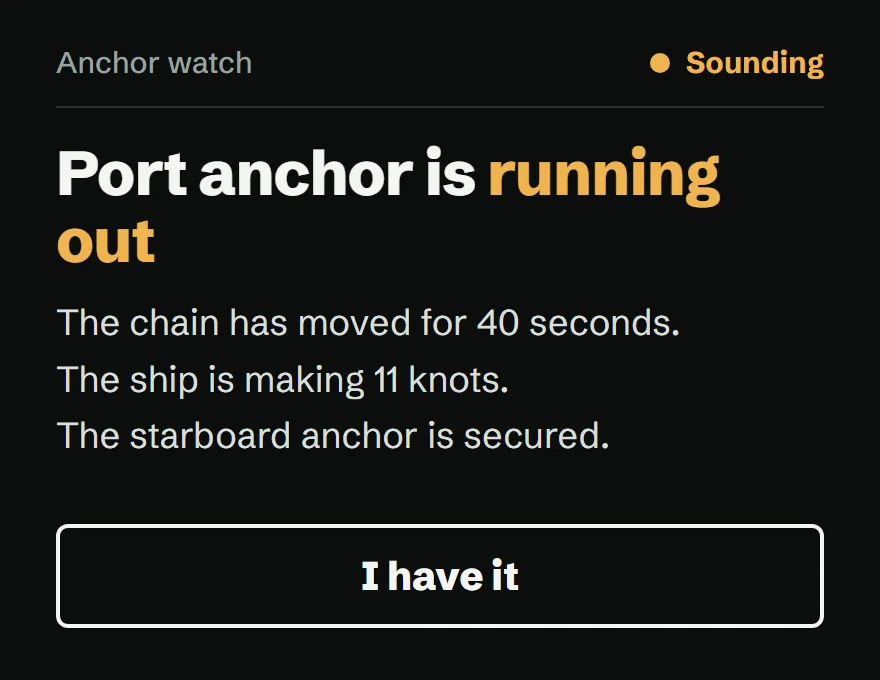
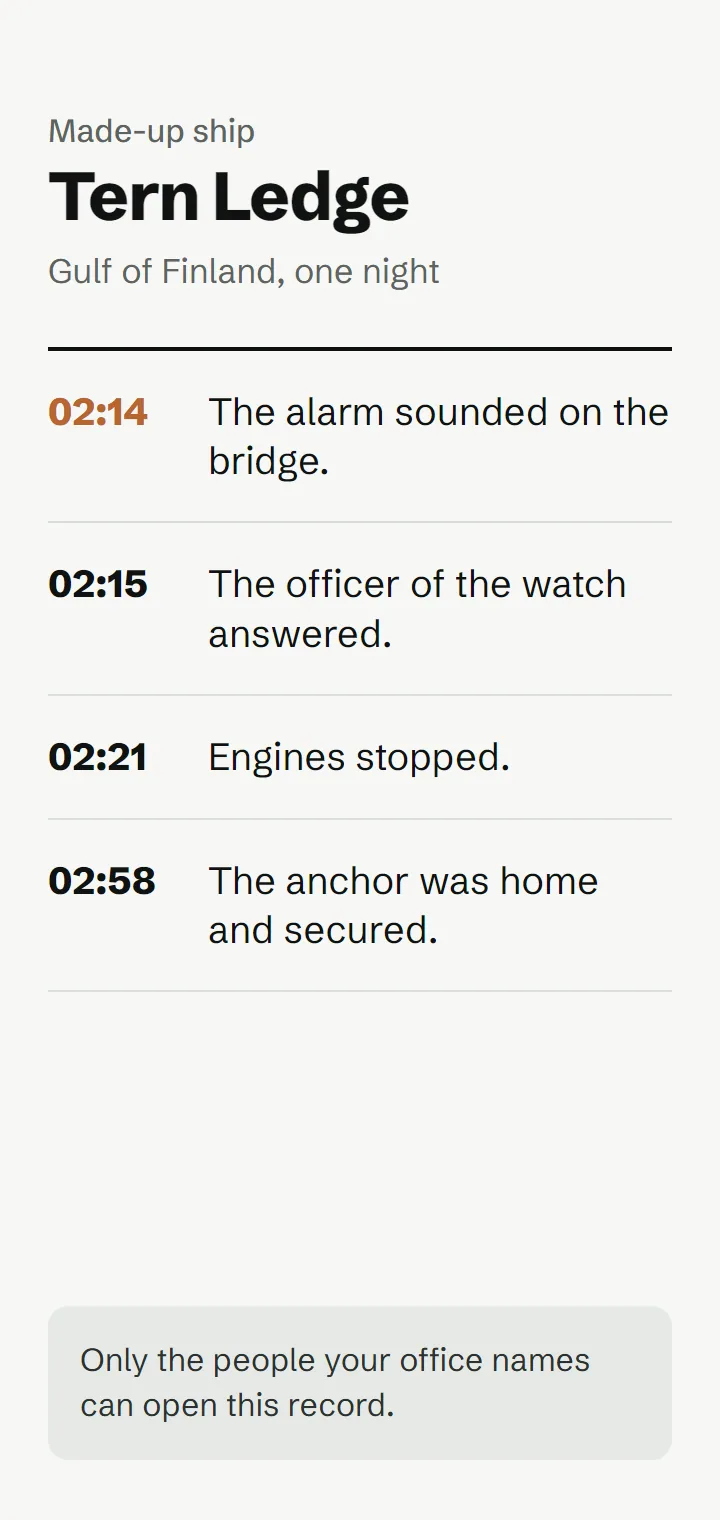
One passage, from the bosun's check to the office ashore at 02:14
Three screens from a passage we invented in the Gulf of Finland. The ship's name is made up.
Secured for sea
Four items ticked, then "Both anchors secured"
On passage
Both anchors secured, with the bosun's last check
Ashore
Port anchor moved 02:14, answered 02:15, engines stopped 02:21


Your members' crews secure anchors as the circulars say, and would feel one drag.
hours
Vezhen's anchor dragged; the autopilot compensated for the pull
In February 2025 a Swedish prosecutor found two of Vezhen's three anchor locks long out of service. A wave opened the third. The crew failed to notice.
Six months on the ships you pick, then one page: how fast each bridge knew
The club reads counts and minutes per ship, never positions or tracks, and only where the member agreed. A night's record stays closed to the club unless the member releases it.

Plan a trial season. Start with how many entered ships cross cable-dense waters a month.
Liisa Rantanen, our Chief Risk Officer, takes the call, with Marta Zielińska, our CEO, on ship questions. It settles which ships, who pays which months, and whether the club sees each season report.
- The count matters: a season is planned ship by ship.
- Afterwards each superintendent sends stopper photos and the bridge wiring diagram.